
You crossed off fourteen things today. You answered every email, sat through three meetings you didn't need to be in, and put out a fire that wasn't yours to begin with. And still somehow you got into bed feeling like you accomplished nothing that actually mattered.
Let's be real: that gap isn't a discipline problem. You're not lazy, and you don't need to wake up at 5 a.m. It's a sorting problem. You've been treating everything that feels pressing as though it's the same thing as everything that's important and those two categories overlap far less than your calendar suggests.
The Time Management Matrix fixes that. It's a four-box grid that separates urgent from important, and it does something most productivity systems refuse to do: it tells you what to stop doing.
Urgent is loud. Important is quiet.
Here's the distinction the whole matrix rests on.
Urgent means it demands attention right now. A ringing phone. A Slack message with three question marks. A deadline someone else set for you. Urgent things announce themselves, and they trigger a reaction before you've decided whether they deserve one.
Important means it moves you toward something you actually care about: your goals, your relationships, your health, the version of your career you're building toward. Important things almost never announce themselves. Nobody sends a calendar invite for "think about where you want to be in three years." Nobody escalates your sleep.
That asymmetry is the trap. Urgent shouts, important whispers, and if you're only responding to volume, you'll spend a decade very busy and not much closer to anything.
The four quadrants
[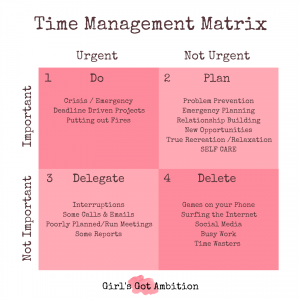
Quadrant 1: Do- urgent and important
Crises. Deadline-driven projects. Genuine emergencies. This is the quadrant where the building is on fire and you are, correctly, holding the hose.
Q1 work is real and it isn't optional. But here's what nobody tells you: a calendar dominated by Q1 is a symptom, not a badge. When you're constantly in crisis mode, it usually means the prevention work — the Q2 work — didn't happen. The report became an emergency because you didn't block time for it three weeks ago. The conversation became a conflict because you avoided it when it was small.
Some Q1 is unavoidable. Living there is a warning light.
Quadrant 2: Plan- important, not urgent
Problem prevention. Relationship building. New opportunities. Real rest. Self-care.
This is the quadrant that changes your life, and it's the one you skip. Every single item here is something you could postpone today with zero immediate consequence — which is exactly why it gets postponed indefinitely.
Q2 is where strategy lives. It's where you have the coffee with someone in a role you want. It's where you take the certification, write the proposal nobody asked for, go to the doctor before it's urgent, and take a weekend that isn't a reward for surviving something.
We'll come back to this one, because it's the entire point.
Quadrant 3: Delegate- urgent, not important
Interruptions. Most calls and emails. Meetings that could have been a message. Reports nobody reads.
Q3 is the sneakiest quadrant because it feels exactly like Q1. Same adrenaline, same urgency, same sense of being needed. But it's someone else's priority wearing your name tag.
This is also, honestly, where a lot of us get stuck because the skill Q3 requires is saying no, or handing something off, or letting a message sit for four hours. If you're the person who always responds first, always volunteers, always picks up the slack, you have probably built a reputation on Q3 work. That's a hard thing to let go of. Do it anyway.
Quadrant 4: Delete- neither urgent nor important
Phone games. Scrolling. Busywork that produces the feeling of productivity and none of the output.
Be honest here, but not cruel. Some of what looks like Q4 is actually rest that you've mislabeled and rest is Q2. The difference is whether you chose it. Twenty minutes on the couch with a show you love because you decided to is restoration. Forty-five minutes of scrolling you didn't choose and don't remember is the drain the matrix is asking you to name.
Quadrant 2 is the whole point
Here's the shift: the matrix isn't really a sorting tool. It's an argument.
The argument goes like this: every hour you invest in Quadrant 2 shrinks Quadrant 1 later. Prevention shrinks crisis. The hard conversation you have on Tuesday is the blowup you don't have in March. The system you build now is the fire you don't fight in six months. The rest you take this week is the burnout you don't recover from next year.
Q2 is compounding interest. And like compounding interest, the cost of skipping it is invisible right up until it isn't.
Which is why the goal is never to "manage your time better" in the abstract. The goal is to move hours out of Q3 and Q4 and defend them in Q2, and to accept that this will occasionally mean disappointing someone who wanted a faster reply.
How to actually use this
Sorting a list once feels good and changes nothing. Here's how to make it stick.
- Audit before you plan. For three days, don't change anything, just log what you actually do in 30-minute blocks. Then assign each block a quadrant. Most people are stunned by how much of their week lands in Q3. You can't fix a pattern you're guessing at.
- Sort your current list, not a hypothetical one. Take everything on your plate right now and put each item in a box. Force the choice; nothing gets to live in two quadrants. Then look at Q3 and ask, item by item: does this have to be mine? Some can be delegated. Some can be batched to a single window instead of interrupting you all day. Some can just be slower.
- Book one Q2 thing this week and protect it like a meeting. Not a list. One thing. Put it on the calendar with a start time and an end time, and treat it exactly like you'd treat a meeting with your boss: you don't move it because someone else's urgency showed up.
That last part is where this either works or doesn't. Q2 has no external deadline, which means the only thing holding it in place is you deciding it counts.
Your takeaway
You don't need more hours. You need fewer of your hours going to things that were never yours, and more of them going to the quiet, unglamorous, non-urgent work that's quietly building the life you're aiming at.
Start with one square. Pick one Q2 item: the certification, the coffee, the eight hours of sleep, the afternoon that belongs to nobody and put it on your calendar before you finish reading this.
Then let something in Quadrant 3 wait. It'll be fine. So will you. ✨
[DOWNLOAD THE WORKSHEET — Time Management Matrix]
Want to go deeper on what "important" actually means for you? Start with Authoring Values because you can't sort your priorities until you know what you're sorting toward.